 +234-703-1978-233
7 Critical Branding Mistakes Nigerian Startups Make
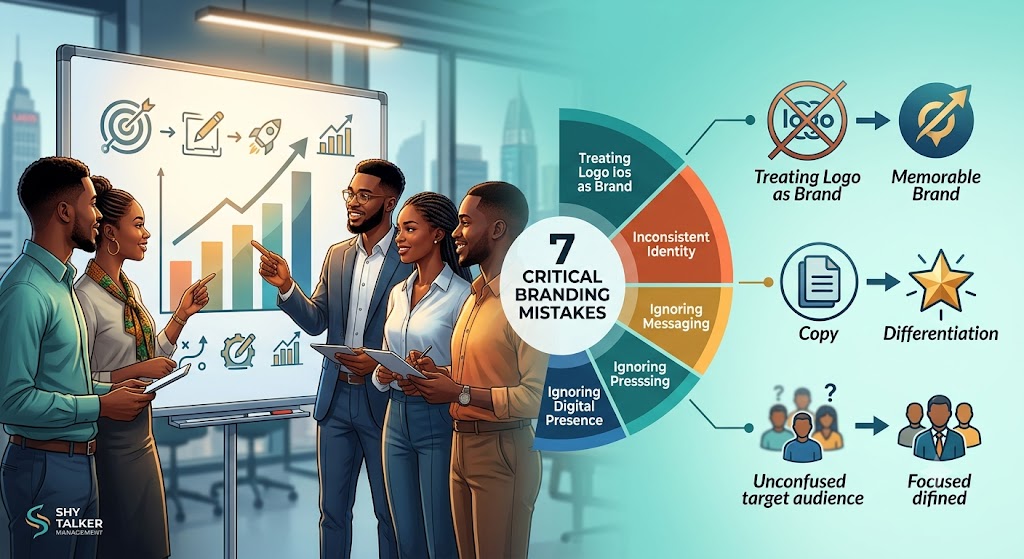
Struggling to stand out in Nigeria’s competitive market? Discover the 7 branding mistakes killing your business growth and how a smart corporate identity strategy can change everything.
If you’ve ever wondered why some Nigerian startups attract premium clients effortlessly while others, with arguably better products, struggle to fill their pipeline, the answer usually isn’t the product. It’s the brand.
In a market as dynamic and competitive as Nigeria’s, your brand is your first sales tool. It speaks before you do. It prices you before you quote. And when it’s done wrong, it costs you far more than a redesign ever would.

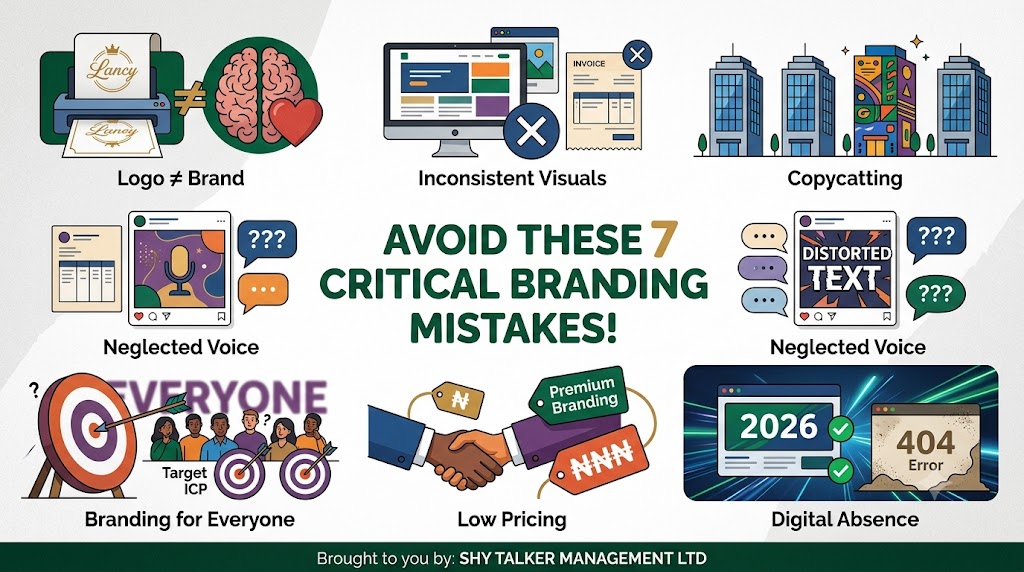
Whether you’re a Lagos-based consultancy, an Abuja tech startup, or an SMB trying to break into B2B contracts, these are the seven most damaging branding mistakes we see Nigerian businesses make — and exactly how to fix them.
Mistake #1: Treating Your Logo as Your Brand
This is the most common misconception we encounter when working as a branding agency in Nigeria. Business owners invest in a logo, print it on business cards, slap it on a website header, and call it branding.
Your logo is a symbol. Your brand is everything your logo represents: your values, your tone of voice, the experience clients have when they interact with you, and the story people tell about you when you’re not in the room.
How to fix it: Start with brand strategy before brand identity. Define your mission, values, target audience, and competitive positioning first. Then let your visual identity: logo, colours, typography; express that strategy, not replace it.
Mistake #2: Inconsistent Visual Identity Across Touchpoints
You have a sleek logo, but your Instagram looks different from your website, which looks nothing like your pitch deck, which bears no resemblance to your invoices. This inconsistency is silently destroying trust.
In B2B especially, clients subconsciously equate visual consistency with operational consistency. If your brand looks disorganised, they assume your business is disorganised.
How to fix it: Develop a small business corporate identity in Nigeria that includes a brand style guide; specifying your exact colours (HEX/RGB codes), approved fonts, logo usage rules, and image style. Apply it everywhere, without exception.
Mistake #3: Copying Competitors Instead of Differentiating
Scroll through the websites of ten Nigerian consulting firms or tech startups and you’ll see the same blue and grey colour palettes, the same stock photos of handshakes, the same generic taglines like “we deliver excellence.”
When you look like everyone else, you compete on price. And competing on price in Nigeria’s market is a race you don’t want to run.
How to fix it: Conduct a competitor brand audit. Identify the visual and messaging conventions in your industry, then deliberately break one or two of them in a way that’s authentic to who you are. Differentiation isn’t about being weird; it’s about being unmistakably you.
Mistake #4: Neglecting Brand Messaging and Tone of Voice
Most Nigerian SMBs obsess over how their brand looks and completely ignore how it sounds. Your tone of voice whether you’re formal or conversational, bold or nurturing, technical or accessible, shapes how clients perceive you just as powerfully as your visuals.
A mismatch between your visual brand and your messaging creates cognitive dissonance. A luxury-positioned brand that communicates like a market stall loses credibility instantly.
How to fix it: As part of your business branding strategy, define 3–4 tone-of-voice traits (e.g., “bold, clear, expert, warm”) and create writing guidelines for your team. Every email, proposal, social post, and website copy should sound like the same person; your brand’s personality.
Mistake #5: Building a Brand for Everyone (And Reaching No One)
“We serve all businesses” sounds inclusive. In reality, it means your marketing speaks to no one specifically, and specific beats general every time.
The most successful B2B brands in Nigeria are ruthlessly specific about who they serve. They speak the language of their ideal client, address their exact pain points, and position their services as the obvious solution for that particular audience.
How to fix it: Define your Ideal Client Profile (ICP). Get granular: industry, company size, annual revenue, decision-maker title, their biggest frustration, their biggest aspiration. Then build your brand around speaking directly to that person.
Mistake #6: Underpricing Because Your Brand Doesn’t Justify a Premium
Here’s a hard truth: the market doesn’t pay for the value you deliver. It pays for the value it perceives. And perception is shaped almost entirely by your brand.
A poorly branded business will always struggle to charge premium rates not because their work isn’t worth it, but because nothing about their brand signals premium. Clients will negotiate harder, question your expertise, and choose cheaper alternatives.
How to fix it: If you want to charge more, your brand must do the heavy lifting. Invest in professional design, elevate your website, improve your proposal templates, and build a content presence that demonstrates authority. This is how rebranding a business in Nigeria directly impacts your bottom line.
Mistake #7: Ignoring Your Brand’s Digital Presence
In 2024, your website is your most important sales asset. Yet countless Nigerian SMBs have outdated, slow, or non-existent websites, and wonder why B2B prospects aren’t taking them seriously.
Your digital brand presence: website, LinkedIn, Google Business Profile, case studies, thought leadership content, is often the first and most lasting impression a corporate client will have of your business.
How to fix it: Audit your digital presence today. Ask yourself: if a potential enterprise client Googled your company right now, would what they find make them want to book a call or click away? Your online brand should work as hard as your best salesperson, 24 hours a day.
The Bottom Line: Your Brand Is Your Most Valuable Business Asset
Every one of these mistakes has the same root cause: treating branding as a cosmetic exercise rather than a strategic one. The businesses that dominate their niches in Nigeria understand that a strong corporate identity isn’t an expense, it’s infrastructure.
A unified brand:
- Reduces your sales cycle (clients already trust you before the first call)
- Justifies premium pricing (perception drives willingness to pay)
- Attracts better-fit clients (the right people self-select in, the wrong ones self-select out)
- Builds long-term equity that compounds over time
Ready to Fix Your Brand?
If you recognise your business in any of these mistakes, you’re not alone, and the good news is that every single one of them is fixable with the right strategy and execution.
We’re offering a free 20-minute branding consultation for Nigerian SMBs and startups ready to build a brand that commands attention, earns trust, and wins better business.
👉 Book Your Free Branding Consultation
No pitch, no pressure; just a clear-eyed assessment of where your brand stands today and what it would take to get it where it needs to be.
Looking for a trusted branding agency in Nigeria that understands the local market and global standards? Let’s talk.
 Previous Post
 Next Post