 +234-703-1978-233
Talent Development

Talent Development: Building for Long-Term Success
In today’s fast-paced business environment, talent development has become the ultimate competitive advantage. Organizations that invest in talent development strategies don’t just fill roles they build resilient, high-performing teams ready for future challenges. This comprehensive guide reveals exactly how to create a talent development program that fuels long-term success, higher engagement, and sustainable growth.
Whether you’re an HR leader, CEO, or people manager, you’ll discover actionable steps, real-world examples, and measurable tactics to turn your workforce into your strongest asset.

What Is Talent Development?
Talent development is the systematic process of identifying, nurturing, and expanding the skills, knowledge, and potential of your employees. Unlike traditional training, it focuses on long-term growth aligned with both individual career goals and organizational objectives.
It includes:
- Skills assessments and gap analysis
- Personalized learning pathways
- Leadership development programs
- Succession planning
- Continuous coaching and mentoring
When done right, talent development transforms average performers into future leaders and creates a culture of continuous improvement.
Why Talent Development Matters for Long-Term Success
Companies that prioritize talent development consistently outperform their competitors. According to industry benchmarks, organizations with strong talent development programs enjoy:
- 21% higher profitability
- 33% higher employee engagement
- 50% lower turnover rates
In 2026 and beyond, with AI disruption and rapid technological change, building for long-term success means investing in people who can adapt, innovate, and lead through uncertainty. Talent development is no longer optional, it’s the foundation of sustainable competitive advantage.
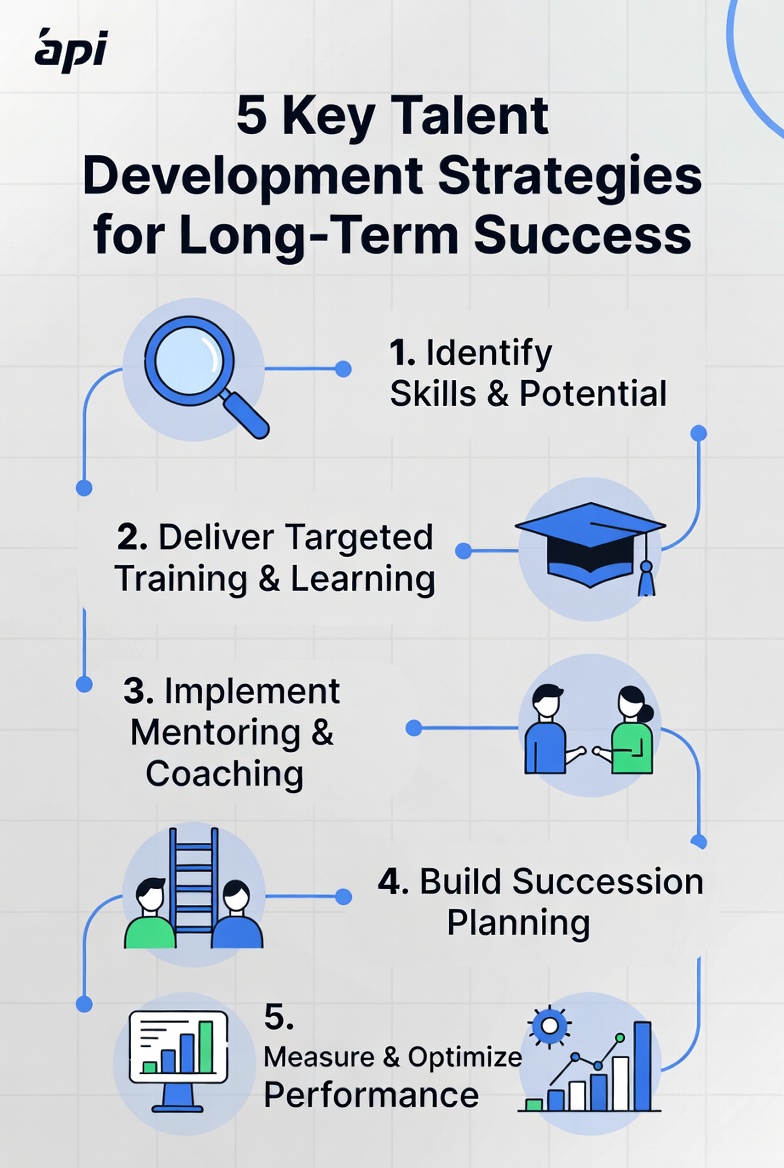
5 Proven Talent Development Strategies for Long-Term Success
1. Identify High-Potential Talent Early
Use skills assessments and 360-degree feedback to spot emerging leaders before competitors do. Create a talent pipeline that ensures continuity.
2. Create Personalized Learning Pathways
Move beyond one-size-fits-all training. Leverage AI-powered platforms to deliver customized development plans that match individual career aspirations with business needs.
3. Build a Culture of Continuous Coaching
Pair employees with mentors and coaches. Regular one-on-one sessions accelerate growth and strengthen retention.
4. Implement Robust Succession Planning
Don’t wait for key roles to open. Develop internal candidates who are ready to step up when opportunities arise.
5. Integrate Technology and Data
Use learning management systems (LMS), performance analytics, and predictive tools to track progress and ROI of your talent development initiatives.
These talent development strategies form the backbone of building for long-term success.
Step-by-Step Guide to Implementing Your Talent Development Program
- Assess Current State: Conduct organization-wide skills audits.
- Align with Business Goals: Ensure every development initiative supports strategic objectives.
- Design Engaging Programs: Mix e-learning, workshops, stretch assignments, and external certifications.
- Launch with Leadership Buy-In: Get executives to champion and participate.
- Track Progress Relentlessly: Set KPIs like promotion rates, skill acquisition, and engagement scores.
- Iterate and Improve: Use feedback loops to refine your approach continuously.
Measuring the ROI of Talent Development
To prove talent development delivers long-term success, track these metrics:
- Employee retention rate
- Internal promotion percentage
- Time-to-productivity for new hires
- Engagement and satisfaction scores
- Revenue per employee
Tools like LinkedIn Learning, Degreed, or Workday can provide real-time dashboards for clear visibility.
Real-World Success Stories
Companies like Google, Deloitte, and Unilever have built legendary talent development programs. Google’s “20% time” policy and Deloitte’s leadership academies show how investing in people creates innovation engines that drive decades of long-term success.
Common Challenges and Solutions
| Challenges | Solutions |
|---|---|
| Limited budget | Start small with high-impact mentoring |
| Resistance to change | Demonstrate quick wins and ROI |
| Measuring intangible results | Use pulse surveys and skill matrices |
| Scaling across departments | Centralized platform + localized delivery |
Conclusion: Start Building Your Talent Legacy Today
Talent development isn’t just about training, it’s about building for long-term success by creating an organization where people thrive, innovate, and grow with the business. The companies that win in the next decade will be those that treat talent as their most valuable renewable resource.
Ready to transform your workforce?
Book a strategy session with us to audit your current programs.
What’s one talent development action you’ll take this week? Drop your response in the comment.
Some Frequently Asked Questions (FAQ)
What is the difference between talent management and talent development?
Talent management focuses on acquisition and retention; talent development focuses on growth and future readiness.
How long does it take to see results from talent development?
Most organizations see measurable improvements in 6–12 months, with significant long-term success benefits appearing in 2–3 years.
Can small businesses afford effective talent development?
Absolutely. Start with low-cost options like peer mentoring, free online courses, and internal knowledge sharing.
 Previous Post
 Next Post